M3 or M4? On paper, the answer should be easy. One is a sedan. One is a coupe. Buy the one that works best for you. But, as with most things in life, it isn’t quite that simple. A handful of variables make the buying process slightly more complicated than just settling on the number of doors. Which one should you actually buy? The answer depends less on lap times and more on how you plan to use the car.
Overall Differences, M3 vs. M4

The biggest difference is obvious: the M3 is a sedan and the M4 is a coupe. That alone makes the M3 easier to recommend for most people. It has four doors, better rear-seat access, and a more usable back seat. If you regularly carry passengers, kids, luggage, or anything larger than a backpack, the M3 is simply easier to live with. Trunk space is also slightly better in the M3, though the difference is not dramatic. You are looking at roughly one suitcase of extra room, or about 1 cubic foot / 28 liters. The M3 also has an advantage in tight parking lots. The M4’s longer coupe doors need more space to open, while the M3’s shorter doors are easier to manage in daily driving. It is not the kind of thing that shows up in performance tests, but it matters if you use the car every day.
Visually, the M4 has the sleeker, more traditional performance-coupe shape. The M3 counters with a more muscular sedan stance, helped by wider fender flares. Depending on the angle, the M3 can actually look more aggressive than the M4, even if the coupe is the sportier shape in theory. Performance is generally identical, as the M3 and M4 are mechanical twins. The M3 usually weighs slightly more than the M4, but not enough to meaningfully change the driving experience for most buyers.
Resale value is another point in the M3’s favor. The M3 typically carries stronger demand because of its lower production volume. It also occupies a smaller niche. There is less competition in the four-door performance sedan segment than there is among coupes and grand tourers, and buyers are often willing to pay more for the ideal car.
The M4 is also available as a convertible. That gives it a body style the M3 does not offer, but it comes with compromises. The M4 Convertible loses additional trunk space to the folding roof mechanism, and the penalty is especially noticeable on F8X-generation cars, which used a retractable hardtop. Those cars are also significantly heavier: an F83 M4 Convertible weighs around 4,055 pounds / 1,840 kilograms, compared with roughly 3,550 pounds / 1,610 kilograms for the fixed-roof F80 M3 and F82 M4. That is a difference of about 505 pounds / 229 kilograms. So, while the M4 Convertible adds open-air appeal, it is not the track day pick.
Generation Gap: F8X M3 vs M4 Differences
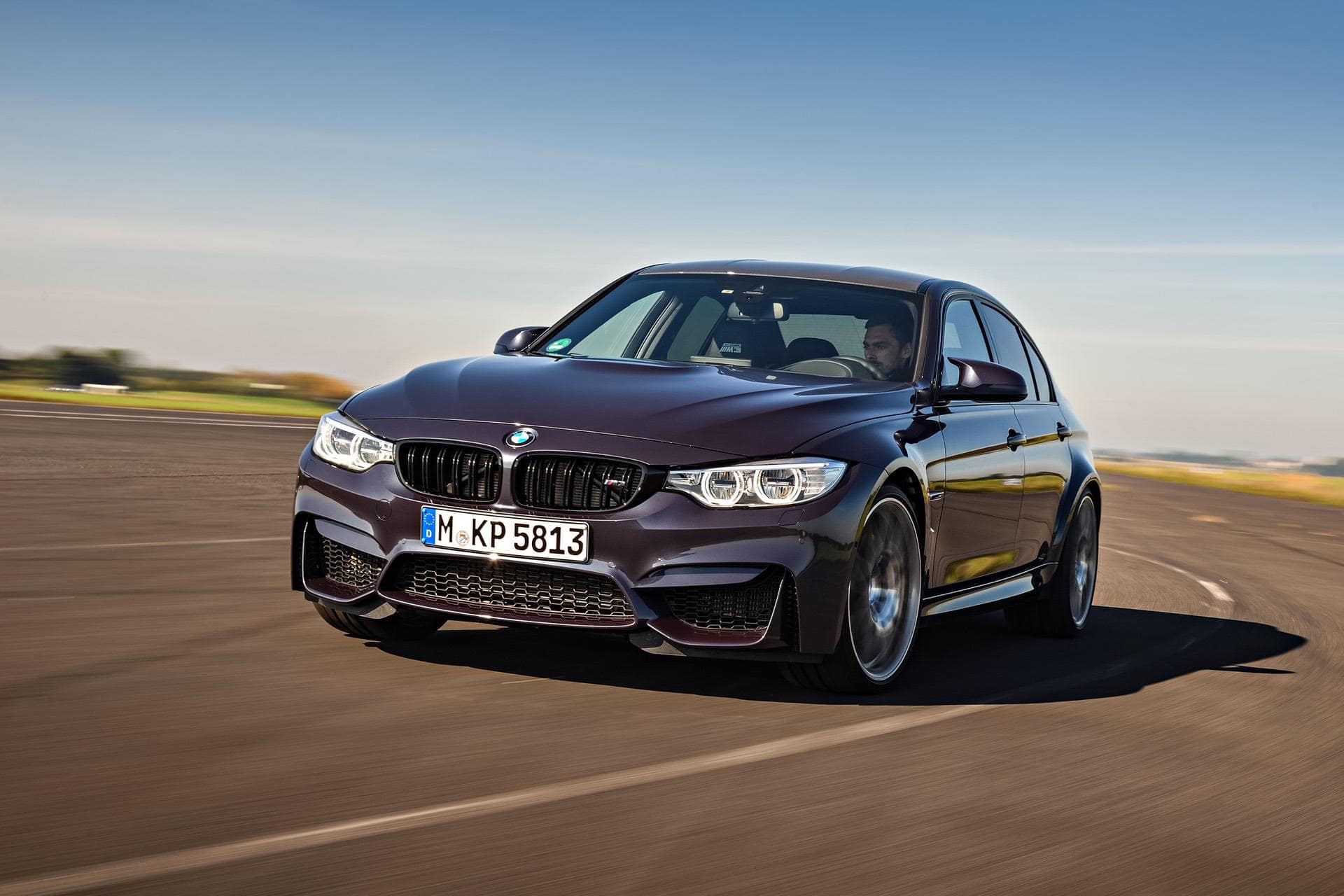
The current G8X-generation M3 and M4 are so closely aligned that the differences are solely aesthetic. But the first-generation BMW M4 had a few minor distinctions worth reading up on, especially for used buyers. Production timing is one of them. The F80 M3 was produced from 2014 until October 2018, while the F82 M4 Coupe continued until June 2020. That means there are newer F82 M4s than F80 M3s, which can matter if you are shopping by mileage, warranty history, or model-year updates.
The lifecycle impulse (LCI; essentially, a mid-lifecycle refresh) timing was different, too. The F80 M3 received its first LCI update with the standard 3 Series in 2016. The M4’s only official LCI arrived later, in 2018. After which, the M3 received a second minor LCI that changed the headlight design to mirror the M4’s. Ultimately, only the final model year F80 enjoyed the fully LCI’d treatment.
There is also the carbon fiber driveshaft detail. Both the M3 and M4 originally used a carbon fiber driveshaft, but BMW removed it from regular production around November 2017 and replaced it with a steel unit. However, some special M4 variants — specifically the M4 CS — retained carbon fiber driveshafts. That is not necessarily a reason to buy one car over the other, but it is the kind of detail that matters to collectors and detail-oriented enthusiasts.
Conclusion: M3 or M4?

For most buyers, the M3 is the better choice. It is more practical, easier to live with, likely stronger from a resale perspective, and nearly identical to the M4 where performance is concerned. The back seat is more usable, the trunk is slightly larger, and the shorter doors make it easier to manage in normal parking spaces.
The M4 still has its place, though. It has a cleaner coupe profile, a more traditional two-door performance-car shape, and the option of a convertible. BMW M4 pricing also stays generally lower than a comparable M3, which can make it a relative bargain considering the identical performance. If you want the absolute newest cars from the F8X generation, you’ll need to shop for an M4. If, on top of all of this, you also rarely use the rear seats, the M4 is arguably the better play.
First published by https://bit.ly/3sM6JoH
Comments
Post a Comment